History
It is important the roots of the current situation. Back in the mid 90s, the clubs of the LFP still had important debts with the Tax Administration and the banks. Some of them still owed money for the renewals of the stadiums used in the World Cup 1982. Until 1996, the LFP negotiated the TV deals with unity, but the digital TV appeared in Spain and two different platforms appeared: Canal Satélite Digital (the current Digital+) and Vía Digital. These digital platforms were ready to introduce the Pay-per-view option in their platforms and football definitely was the candy they wanted. These two platforms started to offer important amounts of money to the clubs and the LFP (the club organization) decided to break the unity and negotiate the deals independently. Every club improved massively their previous situation. And who broke the unity? It was not an imposition of the big clubs, but the smaller clubs who could actually take advantage of the fight of the digital platforms.
But once the first contracts started to expire and the corporate operation that merged the two digital platforms changed the scenario. Digital+, born when Canal Satélite Digital "swallowed" Vía Digital, already had statistics of the PPV, so they really knew the value of each club at that moment. While Barcelona and Real Madrid were able to improve their contracts, most of the remaining clubs saw how the new offers were lower. And this is the situation that has remained stable through these years.

Differences with other European leagues
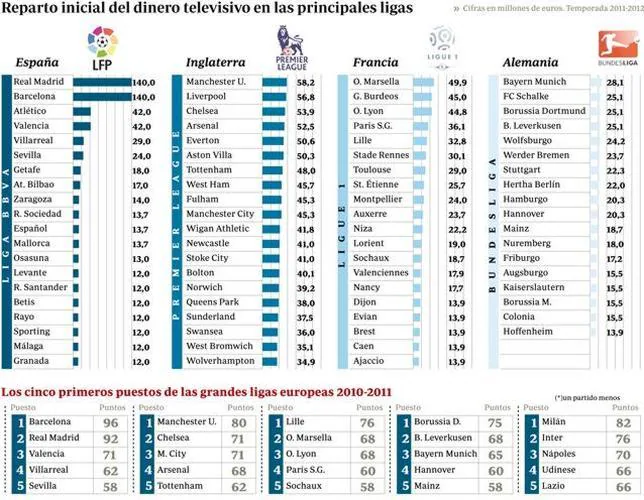
In the other leagues of Europe, there is more unity among the clubs. Obviously, the main reference is the Premier League. In England, the 50% of the TV money is shared among the 20 teams of the Premiership, a 25% depends on the position in the standings and the remaining 25% is negotiated individually by each club.
The situation is not different in other leagues. In France, the 50% of the revenues is shared by all clubs, a 30% depends on the standings and the rest are particular deals between clubs and TVs. In the Bundesliga and the Serie A, the situation is quite similar.
The following graphic shows a comparison between La Liga and the important leagues of Europe (source ABC):
 |
| Source: ABC |
Arguments in favor of keeping the status quo
The ones who defend the current situation use several arguments to defend their position. First of all, this group defend that the system is pure market and the TV deals reflect the real value of the rights of each club. Another system would go against the free market, so the top clubs would actually give the money they generate to clubs who are unable to generate them by themselves.
This group also consider that the current crisis in the Spanish clubs have nothing to do with how the money is shared, but with the mismanagement of some of these clubs, who overspent in the last decade. They consider that the mismanaged club would solve the situation in the short term, but only to fall in the same problems some years later and a new rescue plan would need to be implemented.
Before 2014, the new TV deals must be negotiated. The LFP already decided to act as a unit, but they keep the current situation with small changes. At this point, this group is formed by the two giants, Atlético, Valencia and the smaller clubs. The proposal for the new TV deals which start in 2014 is the following:
 |
| Source: diariosdefutbol.com |
The clubs believe they can receive an overall amount of 800M euros, almost 200M euros more than the current deals. With this proposal, Barcelona and Real Madrid assure the same amount they are receiving nowadays; the smaller clubs would improve their situation (from the 29-12M nowadays to a fix of 25.3M) and they assure assurance in case of relegation (6M in 3 years in case of relegation, 3M in the first year, 2M the second year and 1M the third); and Atlético and Valencia break the unit of the mid-class teams, accepting the deal since they improve their situation, from the current 42M to 49.5M. So the main victims of this proposal are the mid-class of La Liga, the clubs who reject this proposal are: Sevilla FC, Villarreal CF and Athletic Club, basically the clubs who do not have relegation in their horizon.
The alternative of the mid-class
The mid-class and, looking at the polls, most of the fans (even from the big clubs) consider that the pure free market is going to destroy the product: La Liga. In this sense, they consider that, domestically or internationally, this fight of 2 clubs is not interesting, with their point records and constant beatings. Del Nido (Sevilla's president) said that "people turn off the TV after 30 minutes, when Madrid was defeating Zaragoza 0-2" and the same applies to the Barcelona-Villarreal game.
In that sense, they believe it is not stupid to think that the overall product is damaged. This effect may be terrible in the mid-long term, not only for the smaller clubs, but also for Barcelona and Real Madrid, since the final product is not just them, but the whole Liga. If Barcelona and Madrid beat their rivals so easily, given the difference in quality, then what is the point of watching a game knowing the final result? The same Del Nido said that in the next 10 years, it will be impossible to see a champion that is not Madrid or Barcelona.
Villarreal, Sevilla and Athletic defend that La Liga should look at the European leagues to adopt a similar system. They propose a 50%-60% to be shared among the 20 clubs equally, a 20-30% based on variables (position in La Liga) and the rest based on pure audiences. If we make an estimation, using the system of the Premier League or the Ligue 1, this is how things would look like:
 |
| Own source |
In recent times, other clubs showed interest in this new proposal. Clubs like Deportivo, Almería, Espanyol, Real Sociedad or Mallorca are willing to study the alternative idea. This group of clubs consider that the gap between the giants and the worst deal should be 2-1 or 3-1.
Conclussion
As it always happens in life, not everything is black or white. I am with most of the fans and, certainly, La Liga loses some interest with the current situation. Even though I understand the points of those who defend the status quo, La Liga is supposed to be a competition and, in order to compete, there should be some corrections on the pure market (based on audiences) in order to keep the interest. The product LFP are selling is La Liga, not Barcelona nor Real Madrid nor El Clásico.
Aside this, even though the current situation is lucrative for Barcelona and Real Madrid, if the international image of La Liga gets damaged, they will be the first to pay the consequences. Probably, these two clubs aim an European Superleague, but this is unlikely in the short term. In this sense, they must have perspective of their decisions and keep the interest of La Liga they are in.
But, as I said, things are not that simple. It is also important to highlight that the previous years are not just history. They define present and future. Barcelona and Real Madrid defend their interests and they are not irrelevant, after all they are the trademark of our football. These two clubs, in the last 15 years, increased their incomes massively, but the expenses went in the same line. If these two clubs had to accept the system used in other countries, they would lose nearly 100M euros per season. But these clubs still have contracts to pay and they have built a structure of expenses that can not be changed too fast. It would be necessary to have a transition period to adapt, which would not be easy anyway.
At the same time, Barcelona and Real Madrid are not corporations with owners. These two clubs live and compete from what they generate, unlike other European rivals, like Chelsea or Manchester City, clubs with multimillionaire owners who do not hesitate to spend over their own capacity. These are tools that are not in the hands of the old fashioned clubs, like Barcelona and Real Madrid, who are a kind of associations.
In conclusion, things are not so simple, the discussion is in the streets and the clubs must find a solution. I guess we will keep talking about this issue in the future.