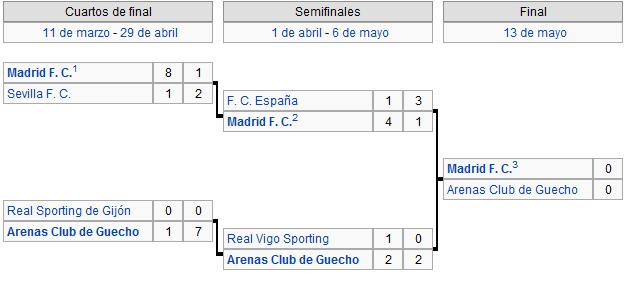
Showing posts with label Alcántara. Show all posts

Saturday, October 15, 2011

History of the Spanish football (VI): 1921-1925, Basque-Catalan dominance, the Real Madrid-Athletic Madrid rivalry and first steps of professionalism

Previous chapter:  History of the Spanish football (V): 1916-1920, the Basque power, the Madrid-Barça rivalry and the "furia roja"

The silver medal of Spain in Antwerp had an extraordinary effect on the game, whose popularity reached unknown levels. New, modern and bigger stadiums were built, like Les Corts, Sarrià, Stadium Metropolitano, Chamartín or Mestalla and others increased their size, like San Mamés in Bilbao. These years were times of domination of the Catalan and Basque football, since their clubs won all the Copa titles. In Madrid, the most important event was the rise of Athletic Madrid as main rival of Real Madrid, setting the base of an eternal rivalry. New regional tournaments appeared, the pressure of professionalism grew and the political powers started to make the first political interventions on the game.


1920-1921


After the Olympic triumph, football gained more popularity among the Spanish fans and the attendances in the stadiums did not stop growing. But this good news went along with internal fights in the Spanish football.

In the Campionat de Catalunya, FC Barcelona showed why they were the favorites to win the title. The team of Samitier, Zamora and Alcántara only lost one game in the whole tournament and won the title easily. In this edition, CE Europa appears as main rival of the Catalans, although not being a real threat. As main event, the relegation of FC España to the Catalan second division. With this relegation and the economic crisis of the club, FC España, who had been a power of the Catalan football in the previous decade, disappeared just a couple of years later.

In Madrid, the King Alfonso XIII gave Madrid FC the "Real" title, so the club started to be called Real Madrid FC since then. But this historical date for the madridismo did not go along with the sport success and the team completes one of their worst seasons in a long time. As a consequence of it, the league was a fight between Racing Madrid and Athletic Madrid. The colchoneros ended up winning the title for the first time in their history and finally appearing as a powerful club in the capital of Spain. It was also remarkable the announcement of a new project: the construction of the Estadio Metropolitano, which was promoted by the real estate departments of the underground train company, which was supposed to be the home of all the teams of the city.

Madrid FC gets Real

In the Basque Country, Athletic Club won the title in Bizkaia, showing the superiority of "Pichichi", Belauste, Acedo and the rest. At the same time, Real Unión Irún wins the title of Gipuzkoa in their fight with Real Sociedad.

The rest of regional champions were Sevilla FC in the Copa del Andalucía, Fortuna de Vigo in Galicia, SR Levante (from Murcia) in the Levante tournament and Sporting de Gijón in Asturias. All these winners got the ticket to play in the Copa del Rey.

This post-Olympics Copa del Rey edition had a sad incident that lowered the level of the competition. Initially, the RFEF gave the final to the city of Seville for the first time ever, but this decision was later revoked  to change the venue of the final from Seville to San Mamés (Bilbao) under the protests of the federations of Catalonia, Levante and Andalusia. These protests were not accepted by the RFEF and, as a consequence of it, the federation of clubs of Catalonia decided not to participate in the competition, which meant that the current champion and one of the main favorites to win the title, FC Barcelona, would not participate.

The first game of the Quarter finals were played in Galicia between Fortuna Vigo and Real Unión. In the first leg, the galegos surprised Real Unión and defeated the Basques easily (5-1). In the stadium of Amaute (Irún), the Basques were forced to win the game to force the replay. In the first half, the good football of Real Unión gave them a (2-0) lead at half time, but the galegos reacted in the second half with a goal that left the game open. Everything seemed closed with a third goal by Real Unión, but Fortuna were able to score the 3-2 with 10 minutes to go. At the end, the result did not change and everything had to be decided in a tie-breaker played in Madrid one week later. In the replay, the game started with the huge impulse of the galegos, who were able to take the lead in the scoreboard, but this domination was balanced by Real Unión in a penalty scored by René Petit before half time (1-1). In the second half, the game did not have a clear owner and, despite Real Unión took the advantage twice, Fortuna were able to tie the game in both occasions. But in the last moments of the game, in the minute 87, the stars of Real Unión met and René Petit gave an assist to the striker Patricio to score the final 4-3.

As a consequence of the protest of the Catalan federation, Athletic Madrid was exempt to play this round. In the other two games, there were two clear favorites who did not disappoint. Athletic Club defeated Sporting in both games, although they were more tight than it was predicted (2-1 and 0-1). At the same time, Sevilla FC were clearly superior to RC Levante and the sevillistas won the game at home (2-0) and in Murcia (0-3).

In the semifinals, Athletic and Sevilla had to face each other. Everything was a farce since the very beginning and these semifinals did not exist. In Seville, the decision of the RFEF to change the venue of the final from Seville to Bilbao was still criticized and the sevillistas gave automatically the pass to Athletic to the final. Both games were played, but they do not count as official games, because the sevillistas went to play to Madrid with some recent signings from Betis that were not allowed to play the competition. Surprisingly for everyone, Sevilla FC was very superior to Athletic winning one of the games (4-2) and drawing in the second one (1-1). The press (this time the one of Madrid) took advantage of the situation to keep criticizing the decision of the RFEF, especially, watching the high level of the sevillistas. The press of Madrid labeled the decision of the RFEF as meddling and applauded the Catalan federation for withdrawing from the competition.

Athletic's lineup in 1921

The other semifinal was for real. The first leg was played in Amaute and Athletic Madrid surprised the Basques in a fantastic first half. The athleticos took a 0-2 lead before half time with both goals scored by Tudiri. The goal of Patricio for Real Unión in the second half was not enough and Athletic Madrid won the game (1-2). In the second leg, in the packed stadium of O'Donnell, Real Unión was a storm of football in the first half and the nerves of the situation betrayed the home team. Despite missing René Petit, the star of Real Unión, Patricio was unstoppable for Athletic Madrid and his two goals, one of them in a penalty, made the local fans fear the worst (0-2, half time). The second half was a totally different story. Athletic Madrid changed their style and started to play combinations on the ground. Still, the result did not change for 25 minutes. This is when Athletic Madrid was a hurricane and the veteran age of the Real Unión players had consequences. Olalquiaga scored the (1-2) for Athletic Madrid in a penalty and only a few minutes later missed another one. Despite this lost occasion, the athleticos were able to tie the game in a goal scored by Triana (2-2). In the last minutes of the game, Real Unión was a joke on the pitch and Triana scored two more goals, while Olalquiaga closed the historical beating on the Basques (5-2) in a magnificent second half. This was the first participation of Athletic Madrid in the Copa and they had reached the final.

Wikipedia

The final was played for the first and only chance in history in San Mamés (Bilbao). This final was an event in the Basque city and the stands of San Mamés were packed by 15,000 (other sources say 20,000!) local fans, while the supposed capacity of the stadium was 9,000. This final was also a special even, the rivals were Athletic Club de Bilbao, the father, and Athletic Club de Madrid, the son, since the team of Madrid was founded by Basque Athletic fans in the city of Madrid and was a feeder club of the Basque one for almost a decade. It was the first time they met in an official tournament ever. Athletic Club wore their red and white colors, while Athletic Madrid used their second uniform (blue and white).

In the early minutes, Athletic Club had the initiative of the game and Sabino Bilbao enjoyed the first chance of the game. In these early minutes, the local team was superior, although Athletic Madrid looked dangerous in the counters. When the match was about to reach half an hour, Pichichi connected with Acedo who passed the ball to Laca to score the first for the Basque team (1-0). Both teams kept enjoying chances, but it was Triana who balanced the game for the visitors (1-1) in a long distance shot. But the happiness of the away team was short, since a messy action inside their box was awarded with a penalty for Athletic Club by the referee Berraondo. Acedo scored the penalty for the 2-1 at half time.

In the early minutes of the second half, the visitors looked affected by the result, but Athletic Club did not took advantage of it. Soon, Athletic Madrid reacted and, when they were enjoying their best minutes, Acedo kicked the ball from out of the box to score the decisive 3-1 for the locals in the minute 68. This goal was a shock for the visitors and this time Athletic did not miss their chance to close the game. Only 5 minutes later, after two shots to the posts by Allende and "Pichichi", the ball fell in Laca's first for the fourth goal of the Basques. The rest of the game had no story and Athletic won their 9th Copa title in their history.

This title was celebrated by thousands of Athletic Club fans in the streets of Bilbao until really late at night, but the press did not miss the chance to make some ironies with the polemic events, recalling the name of Sevilla FC the day after.

Linguasport.com

This game was also the last one of the mythical "Pichichi" (click to read about his story). The legendary Athletic player was not in his best moments and, despite he was just 29, he decided to retire as a consequence of the constant criticism of the local crowd. Only one year later,  "Pichichi" died as due to the typhus illness he suffered to become an icon of the Basque and Spanish football. Athletic placed a bust in the VIP box of San Mamés and, still nowadays, any club that visits the stadium for the first time leaves a bouquet of flowers in it.


1921-1922

With the new season, the Spanish football returned to peaceful manners, closing the polemics of the previous edition. As always, the winners of the regional tournaments were the teams that had the right to play the Copa del Rey. This time, the RFEF chose the Estadio de Coia in Vigo to host the final of the tournament.

In Catalonia, the rise and rise of FC Barcelona did not seem to see the end. The powerful Catalan squad was the big favorite and the results ended up confirming the predictions. The blaugranas won the league, winning 9 of the 10 games, only drawing one. Besides, it was a very important year for the club, who started the construction of their new stadium, Les Corts. The attractive football of the culés used to pack their stadium in La Industria and the club considered it was necessary to build a bigger stadium. At the same time, their biggest rivals, RCD Español were struggling to survive due to the economic crisis of the club and the departure of some players, who were drafted to go to war in Morocco. The españolista president Genaro De la Riva saves the club with his new policies, which include the construction of a new stadium in Sarrià. The crisis of Español is evident and the team lost 10-0 and 0-9 in their clashes against FC Barcelona.

In Madrid, there was an internal crisis in the regional federation, which caused the delay in the beginning of the competition. The league was a close fight between Real Madrid and Athletic Madrid. The tournament was decided in the final clash between madridistas and athleticos, won by the merengues in their visit to Athletic Madrid's home with one game to go.

In Euskadi, Athletic closed a page of their history, with the retirement and posterior death of "Pichichi" and the decline of players like Belauste or Acedo, the team needs a transformation. This transition time in Athletic made the tournament fall in the hands of Arenas Club, who recovered the regional crown three years later. At the same time, in the province of Guipuzkoa, the Real Unión of Petit, Patricio, Emery and Gamborena keeps dominating the league over Real Sociedad.

Real Unión's Patricio Arabolaza


The remaining regional tournaments had some classic winners, like Sevilla FC, Fortuna de Vigo, Sporting Gijón and a new champion in Levante, the Español FC de Valencia.

In the Quarter finals of the Copa del Rey, the most important clash was the one of Arenas Club and Real Madrid, who saw each other's faces again in this competition. In the first leg, played in Getxo, Arenas Club was very superior as the final 4-0 shows. In the second leg, played in O'Donnell, Real Madrid imposed the home factor to force the replay with a clear 5-2. At the end, both teams had to play three replays. The two first tie-breakers ended up with a 1-1 result, but the third was easily won by Real Madrid (3-0) who got the ticket to the semifinals.

FC Barcelona's Ricardo Zamora

Another interesting clash was the FC Barcelona-Sevilla FC. In the previous edition of the tournament, Sevilla FC showed a good image and there was interest to see the sevillistas against the stars of Barcelona. In the first leg, played in the Estadio Reina Victoria in Seville, was balanced  but the barcelonistas ended up winning the game (0-1). However, the Catalans showed no mercy in the second leg, destroying the sevillistas with a clear 7-1. The other two Quarter final clashes had a similar outcome. Real Unión crushed Fortuna de Vigo (4-0, 0-5), leaving the host city of the final without their team in the competition. At the same time, Sporting Gijón showed their superiority over the still developing Valencian football. Sporting clearly beated Español de Valencia (6-0, 0-7).

In the semifinals, the most interesting clash was the one of Real Unión and Real Madrid. Without a clear favorite, Real Unión visited Real Madrid's O'Donnell. The game was tight and the madridistas won the first game with a short 2-1. In the return leg, Real Unión was very superior and the madridistas had no option (4-1). It was necessary to play a replay, which was hosted in San Sebastián. This time the madridistas could not make it to the so wished final and Real Unión were clearly superior (4-0). Four years later, Real Unión was in a Copa final.

Wikipedia


The final was played in the Estadio de Coia in Vigo, gathering 12,000 fans in the stands. Before the game, there was a favorite, FC Barcelona, but the challengers of Real Unión claimed that, given that the match was in neutral ground, they would have their chances. The Catalans were the favorites, given their amazing record of victories, based on the safety of Ricardo Zamora as goalkeeper, the natural talent of Josep Samitier and Sancho in midfield and the attacking power of Paulino Alcántara and the young Sagi-Barba, who had successfully replaced Sesúmaga. In Real Unión, the main weapons were the famous striker Patricio, the veteran quality midfielder René Petit and the solid young defender Patxi Gamborena.

In the early minutes of the first half, Real Unión planned a high intensity game that surprised the blaugranas. The Basque team were able to dominate the match, while the favorites looked nervous and unable to control the game. But when this initial impulse got reduced, the Catalan midfielder Torralba found a hole in the defense of Real Unión to score the first for Barcelona in the minute 22. The goal of Barcelona had its reaction in Real Unión, who looked for the draw. Only 8 minutes after the Catalan goal, Real Unión enjoyed a corner kick, which was headed by Patricio to the net to draw the game (1-1). After this goal, Real Unión kept proving Zamora, who saved Barcelona in this stage. But, once more, after a corner kick, Josep Samitier advanced the Catalans again (2-1). This goal made Real Unión feel anxious and their attacks were clumsy and inefficient. Right before half time, Paulino Alcántara dribbled several players and connected a shot that surpassed the Basque goalie Muguruza to score the third goal of the blaugranas. The 3-1 was the result at half time.

Josep Samitier

In the second half, Real Unión knew about the difficulties to overcome the result, but they gave everything to do it. However, the good attacks of the Basques and the difficulties of Barcelona to control the game did not change the result. Ricardo Zamora emerged as the star he was considered to stop Real Union's chances again and again. When the game was about to finish, with 8 minutes to go, Patricio was able to dribble the barcelonista Martínez-Surroca and the defender ended up tackling the Basque to stop the attack of Real Unión. Patricio reacted punching Martínez-Surroca and this event causes a massive brawl and the invasion of the pitch by the fans. The Basques asked for the expulsion of Martínez-Surroca for the tackle, but the French referee Balway (who had replaced Bertrán de Lis as a request of both teams) rejects to send off the Catalan. The irundarras decided to leave the pitch in a mix of anger for the action and frustration for the result. After 15 minutes of discussions, Real Unión returned to the pitch, but they had lost the concentration. In the last 7 minutes, Barcelona score two more goals (85' Gràcia and 90' Alcántara) to round the 5-1 beating.

Zamora and Patricio were considered the best players of the final. The goalkeeper saved his team in their worst moments and was essential to keep the advantage in many occasions. Patricio, the Real Unión striker, was the best Basque player on the pitch, who missed the football of a dark Petit. The post-final had some sad events, when some Real Unión fans appeared in the celebration of Barcelona to insult the players, which caused the intervention of the police. In one way or another, FC Barcelona had won their 5th Copa title and was probably enjoying one of their best teams ever.

Lingasport.com

1922-1923


The pressure of professionalism was growing. Football still was an amateur sport, but it was a growing business for the clubs, which started to collect high amounts of money via tickets, while the newspapers filled their football pages with advertisements. The debate grew when Ricardo Zamora requested a contract to FC Barcelona, which was denied by Hans Gamper. As a consequence of it, the Español president De la Riva offered a 20,000 pesetas (120 euros) per year contract to the goalkeeper, a very relevant figure back in those times. The RFEF and the Catalan federation reacted and banned Ricardo Zamora during a one year period for breaking his contract without the permission of FC Barcelona. This event raised the debate about professionalism, which was adopted just a few years later.

This event has its consequences in the Campionat de Catalunya. The departure of Ricardo Zamora plus the problems of Sancho and Alcántara to appear in the lineups due to injuries or personal problems had a very negative effect on FC Barcelona. Still the blaugranas fought for the title with their main rival those years, CE Europa. Both teams tied in points after a fantastic season by both sides, but CE Europa won the tie-breaker played in Girona. It was the first and only title of CE Europa in their history, driven by the historical coach Ralph Kirby. This failure made the legendary coach Jack Greenwell resign from his position as coach. Not everything was sad for FC Barcelona, who opened their new stadium, Les Corts, in the summer of 1922, with an initial capacity for 30,000 fans, although the construction did not finish until 1926, reaching a 45,000 fan capacity. Already this season, many Catalan clubs used to rent Les Corts in order to collect more money via tickets.

Les Corts
At the same time, in RCD Español, Genaro De la Riva kept trying to save the club with important investments for the future of the club. Aside the already mentioned signing of Ricardo Zamora, the club approved the construction of a 40,000 capacity stadium, Sarrià. Sadly for the club, during the construction process, the company that was supposed to build the stadium broke and Sarrià opened during the season with a short capacity for 10,000 spectators. Despite the 3rd position of Español in the regional tournament (very far from Europa and Barcelona), the club realize that they collect more money with the unofficial and friendly games of Ricardo Zamora than with the official ones.

RCD Español's new home, Sarrià in 1923
There were also good news in Madrid. The real estate department of the underground train company finished the construction of Stadium Metropolitano, with an initial capacity for 25,000 fans, although it was not officially used until the following season. The initial idea was to build a stadium for all the clubs of Madrid, an idea that was accepted by Athletic Madrid, Gimnástica and Racing Madrid. However, Real Madrid decline the invitation since the club decided to build their own stadium. The madridistas bought lands in Chamartín de la Rosa, back then a town in the North of the city (nowadays a district of the city), where the new stadium would be located one year later.

When it comes to the regional tournament, Real Madrid kept their crown one more year. The athleticos paid their bad results in the early games of the competition and the madridistas recovered the crown in the regional tournament.

Stadium Metropolitano 
In Euskadi, Athletic celebrated their 25th anniversary recovering the regional tournament and confirming their superiority in this level. This triumph was also based on the signing of a new coach, the Englishman Frederick Pentland, the man in the bowler hat, to replace the legendary coach Billy Barnes. Pentland had been an international English player, who started his career as coach with Germany in the previous decade. In 1920, he had also managed the French NT that reached the semifinals in the Olympic Games of Antwerp. After the Olympics, he had signed for Racing Santander, a rival in the regional tournament. Pentland introduced a new style in Athletic, less physical and more technical, with more ground football. Pentland still is the coach with more titles in the history of Athletic. At the same time, in Gipuzkoa, Real Sociedad finished with the 3 consecutive title run of Real Unión in a surprising result.

The rest of regional winners were Sevilla FC in the Copa del Andalucía, Sporting Gijón in Asturias, Real Vigo SC in Galicia and Valencia FC in Levante, the first official title of the ché club. Valencia FC had been founded in the year 1919 in the Bar Torino. The club was founded as a tribute to a football player of the already disappeared Español de Valencia. At that time, there were five clubs in the metropolitan area: Gimnástico, Levante FC (these two clubs, which were located near the harbor, in mariner areas, ended up merging to create Levante UD), Sangunto and Valencia FC. This title was the first of a Valencian team in the Levante tournament, which also gathered clubs from Castellón, Alicante and Murcia. The fame the club got with this title and the support of the middle class allowed them to build a new stadium, according to their new size: Mestalla.
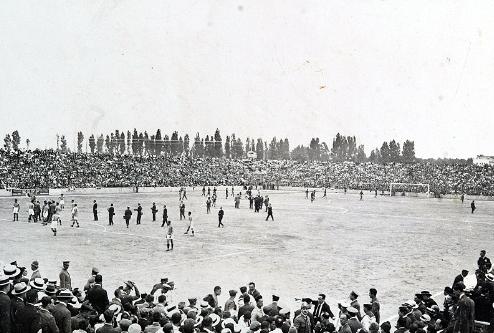
Mestalla

The Copa del Rey was played by all the regional champions, except the winners of the recently created tournaments of Aragón, won by Iberia SD, and Cantabria, won by Patrick O'Connell's Racing Santander, since they had not been officially recognized yet. The RFEF chose Barcelona as venue of the final and the modern stadium of FC Barcelona, Les Corts, to host it.

The luck of the draw made two giants meet in the first round: Real Madrid and Athletic Club. The madridistas were a team in growth, but they were not the team they had been in the previous decades. On the other hand, the arrival of Fred Pentland was an impulse for a renovated Athletic. The Basques demonstrated their superiority at Madrid's home, winning with a clear 1-3. The second leg was much easier for Athletic, who did not have any problems to beat Real Madrid (5-0).

Fred Pentland with Belauste and Iraragorri

It was also interesting to see the debut of CE Europa in the competition against Sevilla FC. CE Europa had defeated the title holders, FC Barcelona, in the regional tournament and they showed why they did. The Catalans crushed Sevilla in Barcelona with an easy 4-0 and got the ticket to the semis winning away too (1-2).

In the other two clashes, Real Sociedad was superior to Sporting Vigo. The Basques lost in Vigo (3-1), but were able to force the replay in the 2nd leg (3-0). The tie-breaker, also played in San Sebastián, was won by the local team too (4-1). The debut of Valencia FC in the competition was good and the Valencians defeated Sporting under the rain at home (1-0). However, Sporting was way superior in Asturias, showing their bigger football tradition (6-1). The replay was played in Oviedo and Sporting eliminated Valencia thanks to the 2-0 result.

In the semis, there was a Basque derby between Real Sociedad and Athletic Club for a place in the final of Barcelona. In Atotxa, the game was tight, but the result did not change in the entire 90 minutes of the match. In San Mamés, the local team was superior and Athletic reached another final, the second in a row. In the second semifinal, CE Europa had to sweat to defeat Sporting Gijón at home (3-2), but the Catalans confirmed the superiority of their football over the Asturians, also winning away (1-2).

Wikipedia

The final was played the pack stadium of Les Corts in Barcelona. 30,000 fans, mostly CE Europa supporters, beat a record of attendance in a Copa final. At this point of history, a final between the Basque and Catalan champions only reflected the superiority of football in the country. In the early minutes, the game had a great intensity by both sides, although the Europa striker, Manuel Cros, enjoyed the best chance of these minutes. While the game advanced, the intensity decreased and, in the minute 37, the Athletic forward, "Travieso", took advantage of a huge defensive error of the Europa players Vidal and Atisús, to steal the ball, face the Europa goalie and score the first for Athletic (0-1). This was the result at half time.

In the second half, the new goalkeeper of Athletic, the 22 years old Arturo Vidal, raised as the star of the Basques. CE Europa was a storm on Athletic's goal and the Catalans enjoyed lots of chances to score the tie. In some occasions, the bad luck and, in some others, Vidal stopped the brilliant attack of CE Europa, led by Manuel Cros. Despite the clear superiority on the pitch, CE Europa was unable to find the way to score their goal, while Athletic looked dangerous in the counter with Germán. At the end, the 0-1 was the final result, which gave Athletic their 10th Copa title and Arturo Vidal a place in history. This was the first title of Fred Pentland with Athletic. Also Félix Sesúmaga, who had joined Athletic after a short stage in Cantabria, was the first player to win 3 Copa titles in 3 different teams.

Lingasport.com


1923-1924

In the autumn of 1923, as a consequence of a political crisis related with the economic problems of the Spain and the war in the colonies in the North of Morocco, the aristocrat and military official Primo de Rivera makes a coup d'etat against the weak liberal democracy with the support of the King of Spain Alfonso XIII,  army, the Catholic Church, the industrial middle-class and diverse conservative elements and established a military dictatorship which had influences of the Italian fascism, with a unique party, suspending the activities of anarchist and working-class parties and unions and setting a centralist state, cancelling the administrative government of Catalonia. This state of political crisis ended up having its effects in football too.

In the Campionat de Catalunya, after the long stage of Jack Greenwell in FC Barcelona, the Hungarian coach of Krakow, Jesza Poszony, who had won the Polish league in 1921 with his previous team, takes the direction of the team. At the same time, the also Hungarian Franz Platko signs for the team after a friendly game between the Catalans and MTK. FC Barcelona crushed all their rivals and recovered the Catalan crown, winning all the games of the league. The previous winners and Copa runner-ups CE Europa ended up in second position, while RCD Español was 3rd, more distracted in their friendly tours showing the legendary Ricardo Zamora than focusing in the official games.

In Madrid, there was also a clear champion that did not find any opposition: Juanito Cárcer's Real Madrid CF, who also remained unbeaten in all the league games. It was also the year of the opening of the Estadio de Chamartín. Real Madrid CF did not want to join the rest of the clubs of Madrid in the Metropolitano and ended up building their own stadium in the North of Madrid. In the league, from distance, Gimnástica was the runner-up, while Athletic Madrid was 3rd. The president Julián Ruete, who had achieved the first title for the club, left the presidency.

Real Madrid's Estadio de Chamartín

In Euskadi, Fred Pentland's Athletic keeps making history with another title in Bizkaia. In Guipuzcoa, Real Unión de Irún won the title again, showing that the defeat of the previous year was just an anecdote in their dominance during this period of time.

In the rest of regional tournaments the winners and participants of the following Copa del Rey were: RC Celta Vigo (club created when Fortuna Vigo and Sporting Vigo, the two giants of the city, merged) in Galicia; Real Sporting Gijón in Asturias; Sevilla FC in the Copa de Andalucía; CN Alicante in Levante; Racing Santander in Cantabria; and RSA Stadium Zaragoza in Aragón.
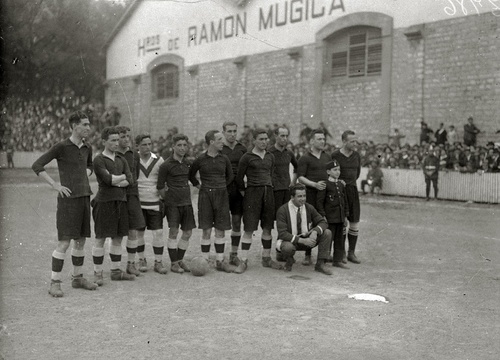
Real Unión in the Copa final 1924

In this edition, the RFEF chose San Sebastián to play the final, in Real Sociedad's home: Atotxa. As a consequence of the appearance of two new regional winners, the format had to change to introduce a previous round with the clubs who made their debut and two "veterans". In this previous round, the veterans won easily. FC Barcelona crushed RSA Stadium in both games (8-1 in Barcelona, 0-9 in Zaragoza), while Sporting Gijón also defeated Racing Santander (7-0 in Gijón, 2-3 in Santander).

In the Quarter finals, the supremacy of the Basque, Catalan and Madrid teams was evident. Real Madrid did not have any problem to defeat the representative of the Levante regional tournament, CN Alicante, winning both games, 4-0 in Madrid and 2-3 in Alicante. At the same time, Real Unión tied in the first leg played at Sevilla FC's home (1-1) to impose their superiority in Amaute (2-0). In a similar way, the current champions, Athletic Club achieved a draw in Vigo against Celta (1-1) to get their ticket to the semifinals at home (6-1). Finally, FC Barcelona had more problems to defeat Sporting Gijón. The Catalans won their game at home (2-0) to be defeated in Gijón (2-0) in the second leg. The replay was played in neutral ground, in Madrid. This time, Sporting retired from the game after the 3rd goal of the Catalans (the result was 3-1 for FC Barcelona when it was abandoned by Sporting), complaining about the performance of the referee.

In the semifinals, all the four favorites met. In both cases, the replay was needed. In the first semifinal, Athletic showed their strength at home, defeating the madridistas with a clear 3-1. But the madridistas responded in their new stadium Chamartín with the same result (3-1). The tie-breaker was played in Madrid too and the madridistas were able to defeat the giant Athletic with a tight 1-0, getting their place in a Copa final for the first time since 1918.

The second semifinal started with the vist of Barcelona to Amaute. The Basque team were superior at home, getting the advantage in this first leg (1-0). In Les Corts, FC Barcelona was superior though, winning 2-0 and forcing the replay. This last game was played in Atotxa (San Sebastián) and broke the supposed balanced results of the semifinals. Real Unión humilliated FC Barcelona with a fantastic 6-1. This result was a shock for the culés and lots of socis (members) sent letters of anger to the club to fire the players "who did not fight". At the end of the season, Hans Gamper returns to the presidency of the club for the 25th anniversary of the club.

Wikipedia

The final was played in the stadium of Atotxa in San Sebastián, very near Irún, the town in the border with France and Real Unión's home. As a consequence of it, thousands of irundarras travel to the capital of Gipuzkoa to support their team. The expectation is high and the small stadium of San Sebastián shows to be too little for the event. Despite their prestige, Real Unión and Real Madrid were not labeled as favorites to win the competition, but they were the executors of Barcelona and Athletic respectively.

The game was brilliant in the first half, without a clear owner, both teams enjoyed several chances to take the lead. In this way, in the minute 10, Juan Errazquin (Real Unión) is denied a goal since he was in offside position. Real Madrid responded with a clear chance missed by Monjardín. In these minutes, Real Unión's football is more physical and powerful, while Real Madrid tried with more combinations. In the last 15 minutes of the first half, Real Madrid's attacks start to be continuous, although the defense of Real Unión, formed by Berges and Eguiazabal, who couted with the help of René Petit and Gamborena, was efficient in their task. The game reached the half time with the 0-0 in the scoreboard, although the press suggested that Real Unión suffered to keep this result, something they did due to their great attitude, while Madrid excelled in the technical aspect.

In the first minutes of the second half, everything seemed to follow a similar path, but it was an anecdote. The brilliant midfielder (and former madridista) René Petit started to appear in the game and Real Unión started to dominate the game. This domination only grew and the madridista goalie Candido Martínez saved his team in this part of the game. And it was in the minute 13, when Juan Echeveste found a hole in the defense of Real Madrid faced and dribbled the goalie to push the ball into the net. It was 1-0 for Real Unión, a goal which was extraordinarily celebrated in the stands of Atotxa, full of irundarras. This goal made react Real Madrid for some minutes, but Real Unión kept dominating the game with a giant René Petit in midfield and a good collective effort to eclipse a hopeless Real Madrid. The madridistas never found their best football in the second half of the game and regretted the missed chances in the first half. The final result was the 1-0 and Real Unión won their 3rd Copa title.

Lingasport.com

Olympic Games 1924 - Paris


After the silver medal in Paris, there was some expectation to see the performance in the Olympic Games held in Paris. At that time, the World Cup did not exist yet and this tournament was the most important international competition. However, the Spanish team did not show a good level and they were eliminated by Italy in the first round of the competition. The game was played in Colombes, the Olympic stadium, and Spain played with one man less since the minute 54, when Larraza was sent off. An own goal scored by Vallana in the minute 87, costed Spain the elimination.

The gold medal was for Uruguay, who showed an extraordinary superiority during all the tournament. Players like Petrone, Scarone, Cea or Romano got fame thanks to their performance in the Olympics. The silver medal was for Switzerland, while the bronze medal went to Sweden.

1924-1925


In this new season, the Spanish football continued in expansion. New regional tournaments and a record of participation in the Copa del Rey. The game was a very popular game and the new stadiums were a reflection of the good health of sport in general.

In the Campionat de Catalunya, after some years of easy domination of FC Barcelona, Ricardo Zamora's RCD Español presented some serious opposition. Since the very first moment the fight was very tight and the main example of it were the sad incidents in Les Corts, on November 23, 1924. In the derby, at some point of the first half, Saprissa, an Español defended, hit Alcántara with violence (lost a teeth) and the consequence of it was a massive brawl, where Josep Samitier ended up punching Caicedo too. The Basque referee Pelayo Serrano sent off Samitier and the angry local fans started to throw coins to the pitch (this is why this derby was known as the La Calderilla, The coins derby). Given the violence in the pitch and the stands of Les Corts, the referee decides to suspend the match and both clubs used the press to attack and blame the other side. If the relationships between both clubs was quite tense, this event only got things worse. The Catalan federation decided to postpone the game to January, but in closed doors. Before that game, the culé coach Jesza Poszony leaves the club missing his native Hungary, where he signed for Ujpest. As a consequence of it, FC Barcelona signed CE Europa's coach, Ralph Kirby. In the doors closed derby played in Les Corts, RCD Español defeats FC Barcelona at home, but despite this result the blaugranas could overcome the problems to end up winning yet another regional title. In this season, FC Barcelona celebrated their 25th anniversary.

FC Barcelona-RCD Español in 1924: El derbi de la Calderilla
In the Campeonato de Madrid, Athletic Madrid already was the main rival of Real Madrid in the city, in a growing rivalry. The colchoneros, thanks to their new president Juan de Estefanía, were able to get the use of the Stadium Metropolitano in exclusive and this stadium became their home for decades. The athleticos were very superior in the league and Real Madrid could not be a rival for them. Athletic Madrid won their 2nd regional tournament, confirming their new powerful status and getting a place in the Copa del Rey.

Athletic Madrid in the 1924/1925 season

In Euskadi, Arenas Club won their 4th regional title and assured the participation in the Copa del Rey over Pentland's Athletic, still in building process. In Gipuzkoa, Real Sociedad and Real Unión continued with their eternal battle, but this time Real Sociedad won the tournament and Real Unión could not defend their title in the Copa del Rey.

The rest of champions in their regional tournaments were RC Celta Vigo in Galicia, Sevilla FC in the Copa de Andalucía, RSC Ovetense in Asturias, breaking the 8 title run of Sporting Gijón; Valencia FC in the Valencian regional tournament (now without clubs from Murcia), Racing Santander in Cantabria, RSA Stadium Zaragoza in Aragón and CD Español of Valladolid in the new tournament of Castilla-León. Also Real Murcia won the regional tournament of Murcia, but this competition had not been recognized by the RFEF yet and this club could not participate in the Copa del Rey.

In the Copa del Rey, the growth in participants, a record for the tournament, forced the RFEF to change the knock-out format of the competition. The new system divided the 11 participant clubs in 4 different groups (3 of them with 3 teams and 1 of them with only 2) in a league system of two rounds. Then the winners of each group would get their place in the semifinals.

The teams in the Group I were FC Barcelona, as main favorite, Valencia FC and RSA Stadium Zaragoza. The blaugranas were very superior in their group, as it was predicted, and they did not have problems to advance to the semifinals. The decisive games were played between culés and chés, and the blaugranas showed their superiority in Les Corts and achieved a decisive draw in Mestalla to confirm their position. As it was expected RSA Stadium were too weak.

Linguasport.com
The Group II was only formed by Athletic Madrid and Sevilla FC, so it was in fact a two leg clash between them. Each team imposed the home factor in order to beat the rival and it was necessary to play a tie-breaker in neutral ground, in Valencia. In Mestalla, Athletic Madrid suffered to beat Sevilla (3-2), but advanced to the semifinals.

Lingusport.com

The most balanced and attractive on paper: Arenas Club, Real Sociedad and Patrick O'Connell's Racing Santander. The games confirmed that this group was going to be a battle between the clubs of Bizkaia and Gipuzkoa. There were lots of draws in this group, but in the decisive moments, Arenas Club was the most efficient team. In a game that was a final of Arenas, the team of Getxo survived to the group defeating Real Sociedad without options in the group. Everything had to be decided between Racing Santander and Arenas Club in Santander, in what it was a perfect scenario for the team of Santander. Despite the surprise was near, O'Connell's team failed to win at home and the point of the draw was enough for Arenas Club to advance.

Linguasport.com

In the Group IV, RC Celta Vigo did not have a rival and rolled over their two weak rivals, RSC Ovetense and CD Español of Valladolid, winning every single game they played and reaching the semifinals of the competition.

Linguasport.com
In the semifinals, the champions of Catalonia and Madrid, FC Barcelona and Athletic Madrid, met in the competition. In the first leg, played in Les Corts, FC Barcelona were superior and got closer to the final (3-2), but Athletic Madrid responded in the Stadium Metropolitano (2-1) to force the tie-breaker in neutral ground. This replay was played in Zaragoza and FC Barcelona closed Athletic Madrid the doors to the final with the 2-1 victory on the colchoneros.


In the second semifinal, as tight as the previous one, Arenas Club were able to impose the importance of the home factor, defeating RC Celta Vigo at home (1-0). However, the galegos failed to do it in the Estadio de Coia and the 1-1 gave the getxotarras the chance to play another Copa del Rey final in their history.

Wikipedia

This final was played in the small Estadio Reina Victoria (Seville) in front of 6,000 fans. The press showed their disappointment with the city of Seville, where people showed that there was less football tradition than in other zones of Spain. The short attendance was an example of it, when the reality was that this game between the Basque and Catalan champions was a unique chance to see high level football in the city. Besides, the long distances and the poor communications between Getxo and Barcelona with Seville, made almost impossible to travel from the cities of the finalists to the venue of the game. On the pitch, once more, two different styles. El Mundo Deportivo defined the style of Arenas Club as "enthusiastic and impulsive football", while Barcelona's style was "mediterranean, precise, fast and scientific".

FC Barcelona started to win the final in the early minutes of the game. After 9 minutes, in what had been a balanced game so far, the quality of the Catalan forwards made the difference. The skilled Segi-Barba crossed the ball to Sancho, who left the ball to Paulino Alcántara who scored the first for Barcelona in a volley. In the first half, despite some chances of Arenas, the game was owned by a fantastic Barcelona, who forced the Arenas' goalie Jauregui to appear in several moments. In the minute 34, the Catalan midfielder Sancho connected a long distance shot that meant the second for Barcelona. The 2-0 was the result in half time. Barcelona had been superior in their football against the impulsive Arenas.

FC Barcelona, Copa winner 1925


Things changed in the second half, when Arenas Club got decided to recover what was lost. Unlike Barcelona in the first half, who had been better but hardly dominant, Arenas were able to close the Catalans in their own field, forcing the blaugranas to make big efforts in defense. As a consequence of it, the Hungarian goalkeeper Platko made a penalty on Mateo. This penalty could have changed the game, but Platko himself saved the penalty shot by Urresti. The missed chance did not make the areneros surrender, but definitely reinforced the confidence of the blaugranas. The last minutes of the game were a constant attack of Arenas, while Barcelona rejected to attack anymore, just defending accumulating people in defense and kicking balls out, a fact that provoked the anger of the fans. In one way or another, the defensive system was efficient and enough to save the good result achieved in the first half. FC Barcelona won 2-0 and their 6th Copa title of their history in a memorable season for the blaugranas.

Linguasport.com

The happiness in Barcelona was evident, the club was celebrating their 25th anniversary with a new title and the club had more than 11,000 members, a record in Spain. In Catalonia, FC Barcelona was a club of masses already and Gamper's slogan "Visca el Barça i Visca Catalunya" got popular. But it is necessary to recall the state of dictatorship in Spain. During a football tribute to the music society Orfeó Català against an English team in Les Corts. The Spanish anthem, the Marcha Real, was received by whistles, while the "God Save the King" was heavily applauded, in a way to criticize the suspension of the admnistrative government of Catalonia. The reaction of the dictatorship was fast and harsh, closing Les Corts for 6 months (at the end, it was only 3 months) and the president and founder of FC Barcelona, Hans Gamper, was sent to the exile, forcing his to return to Switzerland. Some time later, Gamper was allowed to return only under one condition: not to be the president of the club anymore.


Summary of titles


Copa del Rey


10 - Athletic Club (1902, 1903, 1904, 1910, 1911, 1914, 1915, 1916, 1921, 1923)
6 - FC Barcelona (1910, 1912, 1913, 1920, 1922, 1925)
5 - Real Madrid (1905, 1906, 1907, 1908, 1917)
3 - Real Unión Irún (1913, 1918, 1924)
1 - Real Sociedad (1909)
1 - Arenas Club (1919)


Saturday, October 8, 2011

History of the Spanish football (V): 1916-1920, the Basque power, the Madrid-Barça rivalry and the "furia roja"

Previous chapter: History of the Spanish football (IV): 1911-1915, the creation of RFEF, Athletic dominance and first idols

In these five years, the first big icons of football started to appear, the first real stars of football in Spain. In that sense, players like "Pichichi", Belauste, Acedo, Ricardo Zamora, Félix Sesúmaga, René Petit, Santiago Bernabéu, Sancho, Samitier or Alcantara were already well-known by the public and their fame was in constant growth. These were years of Basque domination, with their teams winning titles and playing finals, while Madrid FC and FC Barcelona consolidated their position in their zones. Madridistas and culés broke their good relationshup with a run of hot clashes in the year 1916, which set the base of the biggest rivalry in football. The decade was closed by the first games of the Spanish NT and their silver medal in the Olympic Games 1920.


1915-1916


Copa del Rey


The Spanish football kept growing and, as a consequence of the creation of the RFEF and the Regional federations, a new tournament appeared in Andalusia, who also had the chance to register in the Copa del Rey from this point. Still, the most important tournaments were still played in the classic zones of Catalonia, Madrid and Basque Country.

In the Campionat de Catalunya, FC Barcelona recovered the crown after two trophyless seasons (five, if we do not count the failure tournament of 1913). The culés were totally unstoppable, led by a brilliant Paulino Alcántara, and they won the tournament winning all the games of the league. Only FC España could show some shy opposition. RCD Español ended up in 4th position. In this edition of the tournament, a young 16 years old Ricardo Zamora impress with Universitari SC and ends up joining Español at the end of the tournament.

In the Campeonato de Madrid, Madrid FC won the title 3 years later. The madridistas found their biggest rival in the last winner of the competition, Racing Madrid. A 21 years old Santiago Bernabéu becomes one of the leaders of the team in attacking positions.

Santiago Bernabéu

In the Basque Country, the Campeonato Norte is won by Athletic Club for the 3rd time in a row, after huge polemics with Real Sociedad, which only heated the rivalry between both clubs, and confirming the superiority of the club of Bizkaia once more. As it has been said, the new Copa de Andalucía is created and Español FC Cádiz are the first winners, being Sevilla FC the runner-up. The Campeonato de Galicia was won by Fortuna de Vigo.

All these winners got the right to play the Copa del Rey, but due to economic reasons, Español Cádiz and Fortuna Vigo withdrew before the tournament started. As a consequence of it, there were only 3 participants: FC Barcelona and Madrid FC, who had to play the semifinals, and Athletic Club, who were exempt for being the current champions and got the place in the final automatically.

These semifinals set the beginning of the huge rivalry between FC Barcelona and Madrid FC. The system of the tournament did not count the goals yet to decide the team that had to advance, but the won games. This format and the results had a negative effect on the relationship of both clubs, which had been friendly until then, but got seriously damaged.

Paulino Alcántara
For the first time since 1902, FC Barcelona and Madrid FC met in official competition. The first leg of the semifinal was played in the Velodrome of Barcelona, RCD Español's home, on March 25, 1916. The reports informed about the initial superiority of the madridistas, who went for the victory in the first minutes of the game. The madridistas got the lead in the scoreboard with a goal scored by one of the best players of this era, the French René Petit. But the goal stopped the madridista impulsed and Barcelona started to dominate the game. The star of the Catalan team, Alcántara, tied the game with a magnificent shot, which was labeled as the best of the season for the culés. After the 1-1 in half time, Barcelona kept insisting and found a new goal, this time scored by Martínez. The Catalans ended up winning the game by this 2-1. Despite the result, the Catalans complained about the referee. Despite the big expectations, the game was more physical than beautiful.

The second leg was played in the O'Donnell stadium of Madrid FC, where 10,000 packed the stands. The madridistas went for the needed victory since the first minute against a Barcelona that couldn't count on two important players, like the captain Massana and Viñals. The efforts of the madridistas did not get result and, after 15 minutes of pressure, Barcelona started to dominate and Martínez advanced the away team (0-1). The home crowd, disappointed by the poor game of the madridistas, applauded the Catalans and criticized the merengues. But despite the superiority of the blaugranas, a handball inside the box gave the chance for Madrid FC to score. Santiago Bernabéu tied the game and, only a few minutes later, right before half time, the same Bernabéu scored a nice goal that overcame the result despite the superiority of the Catalans. In the second half, the blaugranas look for the goal that give them the passport to the final during the first 15 minutes, but their football disappeared and Madrid enjoyed their best minutes of football. As a consequence of it, two goals of the madridistas, one of them scored by Petit, set the final 4-1.

René Petit

This is where the polemics start. The RFEF decides that the replay to decide the finalist had to be played in Athletic Madrid's O'Donnell stadium 15 days later. The Catalans protested since the game was in Madrid, despite it was not Madrid's home, although the crowd was mainly neutral. After 2 minutes, Madrid FC scored the first goal of the afternoon, scored by Belaunde, which excited the madridista part of the crowd. The attack of the madridistas kept being efficient and, only a few minutes later, a messy action ended up with an own goal of the Catalan goalkeeper Bru (2-0). The clumsy barcelonistas were near the knock out when Massana touched the ball with the hand, but the shot of Bernabéu was stopped by Bru. Everything changed at that point and Alcantará became the hero of the Catalans. The Catalan striker led the attack of the blaugranas scoring two goals in the last minutes of the first half to tie the game at half time (2-2). The second half declined in beauty and grew in tension. The madridistas found a renovated impulse and, despite the good actions of Bru, Belaunde scored his second goal to advance the local team. Once more, Barcelona had to fight against the result and the reaction was awarded, this time with a goal scored by Bau (3-3). But this time Barcelona kept insisting and a goal of Mallorquín gave the Catalans the lead (3-4). When the game was about to finish, with only 3 minutes to go, a good combination of the madridistas is kicked by Belaunde to the net (4-4) and the enthusiasm gets spread in the stands.

There was a need of an extra time. In the early minutes of the first half, Madrid gets the lead again in a goal scored by Santiago Bernabéu (5-4), who would became the hero of the madridistas at the end. Despite Madrid looked stronger physically and kept attacking, Barcelona caught the rival in a counter and Alcántara tied the game (5-5) in the second half of the extra time. The game kept open and the barcelonistas seemed to score the winning goal when Martínez scored the sixth for the Catalans (5-6). Once more, when the barcelonistas were almost in the final, a crossed ball hits in Massana's hand and the referee Berraondo awarded a penalty for Madrid FC, very protested by the Catalans. In this penalty, Bernabéu tied only 3 minutes before the end of the game. The game ended up with a 6-6 that forced a second replay and the fans applauded the memorable game of the two club under the protests of the Catalans towards the referee and the praising on Bru, the goalkeeper who saved Barcelona in lots of occasions.

The referee Berraondo
This second replay was the decisive one, again in O'Donnell, Athletic Madrid's home, with the same referee Berraondo. This time the Catalans started dominating the game and a superb Martínez advanced the blaugranas in the scoreboard (0-1). This goal made the madridistas react, drawing the game after a combination with a goal scored by Bernabéu (1-1).  The local team kept attacking, but this enthusiasm was stopped by another counter of Alcantara and Martínez. The last scored the second goal for the blaugranas before half time (1-2). In the second half, it was Barcelona who ended up dominating the game, but the madridistas were able to tie the game after a set piece headed by Zabala into the net (2-2). The game got very open in the last minutes of the game. But the polemics started with another penalty, once again very protested. Once more, Bru becomes Barcelona's savior and stopped the penalty, taking the game to another tense extra time.

The extra time was very tense and the consequences were important. Barcelona started dominating and Alcántara missed some chances, but a counter of Madrid is executed by Sotero. The Catalans surrounded the referee Berraondo complaining, since they considered that the goal was scored in clear offside. The game turned ugly, the madridistas wasted time and the crowd got divided in their opinions. Everything exploded after the fourth goal of the madridistas. Another merengue counter ended up in a mess inside the box, which is finished when Sotero kicks the ball in. The blaugranas protested, since they considered there was a foul on the goalkeeper Bru, who was supposedly grabbed by a rival. The ref Berraondo did not make any decision and the goal went to the scoreboard (4-2). The very angry Catalans, led by their captain Massana, left the game 7 minutes before the end, showing their anger against the referee Berraondo, who had awarded the madridistas with 4 penalties (2 of them stopped by Bru) in the run of games and, especially, for the polemic actions in the extra time. As anecdote, Berraondo had played for Madrid from 1902 to 1909 and for Barcelona in the 1913-1914 season, playing also for Real Sociedad in between. Later on, he was the coach of Real Madrid in the late 20s.

The reactions were terrible. The madridistas screamed against the culés for what they considered lack of fair play attitude, while the Catalans targeted the referee, claiming that Berraondo had been Madrid's accomplice in a robbery. In the following days, the Federación Centro issued a prohibition for all the Madrid clubs to compete against FC Barcelona, a reaction that was disapproved by the RFEF later. In Barcelona, the fans made a massive reception for the team, who were applauded by the barcelonista crowd, while the captain Massana expressed the gratitude on the fans and his anger against Berraondo.

Rafael Moreno "Pichichi"

Even before the final, the RFEF had decided that the final of 1916 had to be played in Barcelona, in L'Escopidora, FC Barcelona's home, on May 7. This final was played by Athletic and Madrid under a very tense atmosphere. The events of the games between FC Barcelona and Madrid FC played 15 days before had heated the barcelonistas, who saw a chance to express their anger. At these times, football was still amateur, but had already broken the borders of the middle class to become a popular game. Thousands of fans packed the L'Escopidora and many of them stayed out of the stadium during the game in a very hot atmosphere. The madridistas jumped on the pitch in first place and the whole stadium reacted with anger, booing the merengues, while Athletic was strongly applauded by the fans of the stadium. This kind of reaction were uncommon, but the semifinals were in the minds of many barcelonistas. Despite the press requested calm and expressed their shame on these events, the fans did not hesitate to express their anger against the madridistas.

The game was far from beautiful. Besides the tension, the game was played under heavy rain on a muddy pitch. Athletic started dominating the game and the legendary striker Pichichi put the goal defended by the madridista Teus under problems. After some minutes of boring football due to the state of the pitch, the Athletic forwards, Zubizarreta and Acedo connect and the last gave the Basques the lead in the scoreboard (1-0), which was celebrated by the fans. In this situation, a superior Athletic kept attacking and this time Zubizarreta scored the 2-0, which was the result at half time.

In the second half, the madridistas collapsed, given the hostile atmosphere and the evident superiority of Athletic. Pichichi, Irureta, Zubizareta and Acedo kept enjoying chances. After 15 minutes, Zubizarreta ended up deciding the game with the 3-0, which was rounded 9 minutes later with a fourth goal. Despite the hat-trick of Zubizarreta, the press highlighted the great game of Pichichi, whose dribblings and passes amazed the crowd. Athletic won the game 4-0 and won their 9th title, the 3rd Copa in a row, which allowed them to win the trophy in property.

Source: linguasport.com

The sad events did not finish with the game, since the some radical fans awaited Madrid FC's bus, which was attacked with rocks by culé fans in their departure. The police had to intervene against the masses in order to avoid bigger problems.

In this Copa, Athletic confirmed they were the strongest club of the country and Barcelona and Madrid set the base of an eternal rivalry.

1916-1917

Football kept growing in Spain this season and the Campeonato Regional de Asturias was a new addition to the regional leagues. At the same time, the Copa del Rey grew in prestige with more participants as a consequence of the constant creation of the regional leagues, promoted by the RFEF.

The Campionat de Catalunya was marked by the polemics. The tournament was a close fight between the three main powers of the Catalan football: FC Barcelona, as defending champions; RCD Español and FC España. Despite the dominance of FC España, who recovered their best level, the league was marked by the so called "Garchitorena case". Garchitorena was a new signings of Barcelona, but with three games to go, RCD Español presented a formal complaint to the Catalan federation, claiming that this player was a foreigner that did not accomplish with the rules of the league. The federation estimated the complaint and the games of Barcelona which had this player involved were cancelled and the federation ordered the replays. As a consequence of this decision, FC Barcelona retires from the competition. These events put the club in internal crisis and the only good news are the debut of two important players for the future of the club: Sanchón and Sagi. In one way or another, these incidents did not hide the superiority of FC España, who got the ticket for the Copa del Rey again.

In the Campeonato de Madrid, Madrid FC confirmed their renovated superiority with their 2nd title in a row. The madridistas did not have a rival in the competition and won all the games of the league, with Athletic Madrid coming in 2nd position. With this title, Madrid FC earned their place in the Copa del Rey.

In the Campeonato Norte, after 3 years of Athletic's dominance, Arenas Club Getxo rises as a new power in the Basque football. Athletic starts a transition period, since players like Ibarretxe, Solaun and Eguía retire. As a consequence of it, Athletic lost their right to play the Copa in favor of Arenas Club. In the Campeonato de Galicia, Real Vigo Sporting Club wins the competition. In the Copa de Andalucía, the two oldest clubs of the region, Recreativo and Sevilla start a stage of close rivalry. In this 2nd edition, Sevilla FC wins the title. The Campeonato Regional de Asturias won by Real Sporting Gijón in his first edition.

The Copa del Rey was played by all the regional winners and the competition found a new life with the rise of participants. A draw decided the four clubs that had to play the Quarter finals and there were two exempt clubs: Real Vigo Sporting and FC España. In the first round, Madrid FC faced Sevilla FC and Arenas de Getxo met Sporting Gijón.

Source: Wikipedia

The first leg between Madrid FC and Sevilla FC were played in Madrid. In the stadium of O'Donnell, Madrid trashed Sevilla with a magnificent 8-1. At the same time, the Basque Arenas Club won their away game at Gijón, defeating Sporting with a 0-1. In the second leg, Arenas Club trashed Sporting (7-1) to advance to the semifinals. In Seville, Sevilla were able to defeat Madrid in a surprising 2-1 that forced a replay. This tie-breaker was played the following day, also in Seville, but this time Madrid FC confirmed their favorite role, defeating the sevillistas with a clear 0-4.

In the semifinals, first leg, Madrid FC faced the Catalans FC España at home. The madridistas were very superior against the powerful Catalan club, winning comfortably (4-1). At the same time, the Basque Arenas Club had to suffer to defeat the Galegos of Real Vigo SC with a short 2-1. In the second leg, Arenas were very superior and achieved a 0-2 victory in Vigo, which allowed them to play their first Copa final in their first participation. In Barcelona, Madrid was surprised by FC España, who were stronger in Catalan lands (3-1) forcing the replay. This replay was played in Barcelona too, 2 days later, which ended up with a 2-2 that was suspended after the extra time due to lack of light. 19 days later, the final replay was played, also in Barcelona. This time, the madridistas did not miss their chance and won 0-1 away, reaching a new Copa final.

This final was played in Barcelona, in the stadium of Muntaner, RCD Español's home (and FC Barcelona's home in the 1900s), on May 13, 1917. 5,000 fans attended to this game, but this time the atmosphere was different. The crowd was more friendly and there was not an evident support on any team, as it had happened in the polemic Copa of 1916. The game was beautiful in the first half, each team with their own weapons: the madridistas showing a better treatment of the ball, while the Basques bet for a more physical football. In the second half, the level of football declined and got more tense, but the result did not change in the 90 minutes (0-0). In the extra time, the tiredness appeared and the game was monotonous. Despite the reports confirmed that Madrid FC was the best team on the pitch, the final 0-0 forced a replay, which had to be played 2 days later.

The replay was played in Muntaner again, but with a lower attendance of 2,000 fans, given that it was a labor day. In the first half, Arenas Club surprised the madridistas, who looked very clumsy in the first minutes of the game. As a result, Suárez scored for the areneros, advancing the Basque club in the scoreboard after 15 minutes. During the first half, the game was marked by the superiority of Arenas Club and the 1-0 was fair. In the early moments of the second half, Arenas kept looking for a goal to open a decisive gap, but the Basques started to pay their physical effort, while Madrid FC started to grow with their own style: combination and short passes. The game changed and Madrid haunted Arenas goal and, with 16 minutes to go, the referee awarded Madrid FC with a doubtful penalty that was stopped by the Basque goalie Jauregi. Despite this missed chance, Madrid only needed one more minute to score: René Petit (1-1). The tie was the result at the end of the 90 minutes. Since both teams wanted to avoid more replays, the referee decided to play extra times of 20 minutes until a team could win the game. After the first 20 minutes of extra time, the 1-1 was still in the scoreboard, but only 3 minutes after the game was retaken, Ricardo Álvarez scored the 2-1 for Madrid FC, which was a fair result given the performances of both teams in this part of the game. In the last minutes of the decisive extra time, Madrid FC kept insisting and the result was not bigger due to the great game of the arenero goalie Jauregi. Madrid FC won the game 2-1 and their 5th Copa title. The madridistas were received in Madrid by a thousand of fans, who cheered their heroes in the midnight of the capital.

Source: Lingasport.com

1917-1918

In Catalonia, the Campionat de Catalunya was won by RCD Español, which was the first title of the club in three years. Español, where a very young Ricardo Zamora started to write his legend, dominated the tournament, having FC España as main rival in the competition. In Barcelona, the internal crisis continued and Gamper returned to the presidency of the club once more and signed the former barcelonista player Jack Greenwell as new manager. Greenwell was the second coach of the club, succeeding the also English coach Mr. Barlow. 

The Campeonato de Madrid was won by Madrid FC by the third time in a row. Despite the loss of René Petit, one of the stars of the team, who prefered to leave his club in order to return to the city where he grew up in his childhood, the madridistas kept showing their supremacy in the capital of Spain. Athletic Madrid presented some opposition, but could not avoid the victory of the madridistas.

In the Basque Country, the Campeonato Norte had a new champion: Real Unión de Irún. At that moment, the Basque football had the most powerful clubs. Real Unión de Irún was created in 1915, when Racing Irún and Sporting Irún merged. In Gipuzkoa, Real Unión found the support of the east zone of the province, while Real Sociedad was the team of the capital, the rivalry among them was huge back then. In Bizkaia, Athletic still was in transition time, while Arenas Club were one of the powers in those years. 

Real Unión Irún in the Copa del Rey final 1918
In the rest of regional tournaments, Recreativo de Huelva defeated Sevilla FC in the final of the Copa de Andalucía. In the Campeonato Regional de Asturias, Sporting Gijón won their 2nd consecutive title. In Galicia, RC Fortuna de Vigo were the winners.

All these winners played the Copa del Rey. In the draw, Recreativo de Huelva and Fortuna Vigo were exempt from playing the Quarter finals. In this round, in order to save costs, Real Unión de Irún and Sporting Gijón decided to play the pass to the semifinals in just one game in a neutral stadium. The game played in O'Donnell had the expected result and the favourites, Real Unión, defeated Sporting Gijón without much problems (4-1). In the other semifinal, played on two legs, Madrid visited Español's Muntaner stadium. The previous winners of the tournament were clearly defeated by Español, who played their best game of the season, according to the reports in the press. The game was decided in the first half with the goals of Reig and Gràcia, who scored two goals for the final 3-0. In the second leg, played in Madrid's O'Donnell, the story was different though. Despite the game was ugly due to the weather conditions, Santiago Bernabéu scored the winning goal for the madridistas after an error of the goalkeeper Ricardo Zamora (1-0). The replay was hosted in Athletic Madrid's O'Donnell. The madridistas went for the victory in the early moments of the match and, in only 10 minutes, Posada and Bernabéu gave the madridistas a comfortable advantage. Right before half time, Gràcia could reduce the distances with a goal that turned out useless, since the 2-1 did not change until the end of the game.

In the semifinals, Madrid traveled to Huelva to face Recreativo in the Velodrome of the city. Since the very first minutes of the game, Madrid showed why they were the favorites and two early goals scored by Posada and Bernabéu gave them a result that allowed them to save efforts. The reports said that Madrid won, not even needing to play at their best level. In Madrid, the madridistas only confirmed why they were labeled as favorites. The madridistas were the best team during all the game and Álvarez scored the first goal for the merengues 5 minutes before half time in a penalty kick, which was the second of the game, although the first was missed by the same player. In the second half, Recreativo could only fight, while Madrid developed a better football and the two goals of Posada and the one of Bernabéu gave Madrid the ticket to the final for the third time in a row. The other semifinal was played in neutral ground, in Madrid, only a few days after the previous round, by Real Unión Irún and Fortuna Vigo. Once more, the Basque team showed they had no rival in this season and clearly defeated their rivals, improving the image shown in the previous round. Real Unión won by a clear 4-1 after leading the scoreboard with a 2-0 at half time.

Wikipedia

The final was played in O'Donnell, Madrid, on May 12. This final definitely was played by the two best teams of the moment: Madrid FC, the current champions of the competition, and Real Unión, the new rising power of the Basque football. The reports say that the first minutes were calm and none of the finalists decided to go for the victory. Everything started to change when René Petit, ex-madridista now in Real Unión, put his team on his shoulders, giving the irundarras the control of the game. The match was not exempt from polemics and in the 49' of the first half, a shot by Juan Legarreta, captain and one of the stars of the Basques, is stopped by Teus in what was a ghost goal, which was awarded by the goal referee and, as a consequence allowed by the principal ref, Pepe Torrens. This goal was very protested by the madridistas and the crowd in general. In the Catalan newspaper, El Mundo Deportivo the goal was not questioned, while the Madrid located ABC clearly stated that only the ref saw this goal and suggest that Real Unión should give the referee the socio card.

Real Unión's Juan Legarreta
In the second half, Real Unión kept pressuring the madridistas in the first minutes, but the game changes in few minutes, when in the first counter of the madridistas, the local team claims that there was a handball by a Basque defender. The referee Torrens let the game continue and the madridista fans protested in the stands. But, only some minutes later, there was a similar action with the same result: the supposed handball is not awarded by the referee with a penalty. At this point, the madridista supporters invade the pitch stopping the game in protest. The police and the directors of Madrid had to calm the fans in order to continue with the game. After these events, the madridistas kept attacking and enjoyed chances to tie the game. However, in a counter, the irundarras found Legarreta, who connected a powerful shot from out of the box that entered in Teus' goal after hitting on the crossbar when there were five minutes to go. Despite Madrid FC kept attacking, the result did not change anymore and Real Unión won their first title (the 2nd, counting on the one achieved by Racing in 1913. 

The reports of ABC and El Mundo Deportivo do not hesitate to hype the game of René Petit. The French-Basque player, who had always played in Madrid FC, for the team of the city he had been living since he was a 12 years old student, became the executioner of his former team. Despite the good reports about the madridistas Teus and Bernabéu, the irundarras Petit and the twice goal scorer Legarreta gave Real Unión de title.

Linguasport.com
1918-1919

In this season, two new regional tournaments appeared in the scene: the Campeonato Regional Levantino, which gathered clubs of the regions of Valencia and Murcia and, at the same time, as a consequence of an internal crisis, the Campeonato Norte got divided in two: the Campeonato Regional de Vizcaya, including clubs of Bizkaia, like Athletic Club and Arenas Club, and Santader, and the Campeonato de Guipuzcoa, which only had clubs of the province, like Real Unión de Irún and Real Sociedad, and also from Navarra and La Rioja.

In the Campionat de Catalunya, the work of Hans Gamper and Jack Greenwell with FC Barcelona showed goods and the culés completed a good season to recover the Catalan crown three years after their last title. The barcelonistas just lost one game in the whole tournament, while RCD Español were the runner-ups and FC España ended up in third position.

At the same time, in the Campeonato Regional Centro, Madrid FC's dominace saw an end and the title went to the quarter of Chamberí, where Racing Madrid won their second regional tournament in history. Racing Madrid dominated the league without much opposition and the madridistas were the runner-ups, without being a real threat for Racing.

In Bizkaia, Arenas Club de Getxo won the first edition of the Campeonato Regional de Vizcaya, and their second regional title, while Athletic still struggled in their 3rd year of crisis. The neighbor league of Campeonato de Guipuzcoa ended up in Real Sociedad's hands, who defeated the current winners of the Copa del Rey. As a consequence of it, Real Unión could not defend their title in the following competition.

Arenas' Felix Sesúmaga
In the rest of regional leagues, Sevilla FC won their second Copa de Andalucia. Fortuna Vigo recovered their lead in Galicia and Sporting Gijón repeated in Asturias. CD Aguileño, from Aguilas, a town of Murcia, won the first Campeonato Regional Levantino. All these 8 clubs would play the Copa del Rey to close the season.

The first leg of the Quarter finals was played at the end of March 1919. Sevilla FC directly advanced to the semifinals without playing a single game, since CD Aguileño withdrew in the last moment. In L'Escopidora, FC Barcelona destroyed the winners of Gipuzkoa and defeated Real Sociedad with a clear 6-0. In Bizkaia, Arenas de Getxo did not find a rival in the winners of Madrid, defeating Racing by an impressive 8-2. In Vigo,Vigo Sporting and Sporting Gijón tied 2-2, a result that favored the visitors with the 2nd leg in sight.

The second leg during April. FC Barcelona impressed everyone defeating Real Sociedad (1-3) with a clear superiority. The barcelonistas appeared as one of the favorites to win the tournament, eliminating one of the most powerful clubs of the competition. In Madrid, Racing defeated Arenas Club (2-0) and forced a replay that was also played in Madrid in a neutral pitch, although the tie-breaker had a different outcome and the Basques advanced to the semis, winning with a clear 1-3. In Gijón, the local team and Vigo Sporting tied again (1-1). The replay was hosted in Santander and this time the galegos of Vigo Sporting got the ticket to the semis, winning 3-0.

Card of FC Barcelona's Viñals
In the semifinals, there were two clear favorites, FC Barcelona and Arenas Club, who did not give space to surprises. In the first leg, the Catalans defeated Sevilla with some problems (4-3). The away game, played in Madrid with the agreement of both clubs, was easier for the blaugranas (0-3). In the other semifinal, Arenas Club also imposed their strength over their rivals, winning 0-2 in Vigo. In the second leg, Arenas Club just confirmed their talent and did not have problems to humiliate Vigo Sporting with a clear 6-1.

Wikipedia
The final was played on May 19 in the Martínez Campos stadium, Racing Madrid's home, which was packed to see the two best teams of the season. It was the first visit of Barcelona to Madrid since the incidents of 1916 and the culés found the hostility of the fans, who clearly supported the areneros. There was not a clear favorite to win the final and, in the first minutes of the final, both teams played with some caution. But very soon in the game, in the minute 15, Félix Sesúmaga started to write his place in history, dribbling two barcelonistas and shooting to beat Bru, advancing Arenas in the scoreboard. These were the best minutes of the Basque team, who enjoyed some chance to open a bigger gap. But, in the last 15 minutes of the first half, Barcelona were able to change the direction of the game and played their best minutes of the rival. At that moment, almost reaching the half time Viñals, who was the best barcelonista on the pitch, tied the game.

In the second half, nothing changed and Barcelona kept showing superiority. Once chance after another and "Lakatos" scored the second goal of the blaugranas. The Catalans kept searching a winning goal, but the Basque goalkeeper Jaúregui kept Arenas Club in the game, saving his team from the defeat. With ten minutes to go, Arenas Club could break Barcelona's defense and Sesúmaga scored his second goal of the final, when the barcelonistas almost had the match in hand. Despite the last attempts of the barcelonistas, the 2-2 was the final result after 90 minutes.

Both teams agreed to play an extra time of 30 minutes divided in two halves. This extra time was a very different story. The Catalans felt the shock of the draw in the last minutes of the game and the physical effort. Arenas Club looked stronger and toyed with the blaugranas. As a consequence of it, Sesúmaga completed his hat-trick scoring the third goal for the Basques after 6 minutes and, right before half time, Peña scored the fouth for Arenas. The last minutes of the game did not have a story, the barcelonistas were totally down and Arenas completed their party with a fifth goal in the last minute of the game, scored by Ibaibarriaga. With this 5-2, Arenas Club won their first Copa title in their history, two years after their defeat against Madrid FC.

The game of Sesúmaga impressed everyone and Gamper was able to convince the Basque star to join Barcelona's project for the following season.

Linguasport.com

1919-1920


The Campionat de Catalunya found a new dictator: FC Barcelona. Hans Gamper decided to leave the presidency in the summer of 1919, but his heritage was one of the most important Barcelona teams in history. During the summer, before the new season, Barcelona completed two important signings: An 18 year old Ricardo Zamora joined from the eternal rivals, RCD Español, after personal disputes with the Board. At the same time, a 17 year old Josep Samitier accepted Gamper's offer to join the club from FC Internacional. These two players were going to set an era in the Spanish football and were considered icons, even appearing in advertisements of those years. Besides, as it has been said before, one of the best strikers of those years, Félix Sesúmaga, the star of Arenas Club, also joined Barcelona. All these players were additions to an already magnificent squad, who also counted on the striker Paulino Alcántara, Viñals, Sancho or Vicente Martínez. As a result of it, Barcelona wins all the games, except a draw, and wins the Catalan tournament with an impressive gap on their main rivals, SC Sabadell. RCD Español ended up third. This attractive team got the support of the club, who already counted on 3,000 socis. The stadium of L'Escopidora located in the Industria street started to be too small and the club decided to start the project of the new stadium: Les Corts.

In Madrid, the Campeonato Centro was a close fight between Madrid FC and Athletic Madrid, who started to appear as the main threat of the madridistas in the local level. At the end, the madridistas won with a one point gap over Athletic Madrid and two on Racing Madrid. Madrid FC, once more, proved their superiority in the capital of Spain. As one of the most important events in the future of football in Madrid, the City council projected the construction of the Stadium Metropolitano de Madrid, which would be Gimnástica's, Racing's and, especially, Atlético Madrid's home for decades.

At the same time, in the Campeonato Regional de Vizcaya, Athletic Club recovered the supremacy in the Basque football after three years of failures. Athletic counted on important players like "Pichichi", Acedo, Belauste and Sabino, who also formed the core of the first Spanish national team. In the Campeonato de Guipuzcoa, Real Unión dethrone Real Sociedad and won the title.

The remaining regional winners were: Sevilla FC in Andalusia, Sporting Gijon in Asturias and Vigo Sporting in Galicia. The tournament of Levante remained empty, since the two finalists, Gimnástica de Valencia and Cartagena did not agree to play the final. As one of the most remarkable events, this 1919 was the year of the foundation of a historical club: Valencia Club de Futbol.

In the Copa del Rey, since there were not 8 teams to complete the Quarter finals, a draw decided the exempt team: Real Unión de Irún. At the same time, Sevilla FC withdrew from the competition, since they wanted to play the two games in a neutral ground of Madrid and FC Barcelona declined the petition. So the quarter finals got reduced to four teams. The draw set a fantastic clash between the two clubs with more Copa titles at that moment, Madrid FC (5 titles) vs Athletic Club (8 titles). Before the first game played in O'Donnell, Madrid, the reports of the press of Madrid talk about an inferiority complex among the madridistas before the game. The fame of players like "Pichichi", Belaunde or Acedo, whose curriculum vitae was full of titles, made them favorites. In the first minutes of the game, Madrid seemed cautions given this atmosphere and everything was confirmed by an early goal scored by José Mari. But this goal changed the attitude of the madridistas, who got rid of the pressure they were feeling to be superior in the rest of the game. Before half time, Monjardín tied for Madrid FC. The 1-1 was the result at half time and at the end of the game. The madridistas enjoyed the best chances and the press protested about the performance of the referee, in decisions against the local team. In El Molinón, Gijón, Sporting Gijón and Vigo Sporting, who saw their faces again in this competition, tied (0-0).

In the second leg, played in San Mamés, Athletic got an early lead after 3 minutes in the scoreboard thanks to a penalty scored by Laca, the hero of the Basques that afternoon. From that point, the madridistas started to control the game thanks to their combinations in midfield, while the reports talk about the bad game of "Pichichi" and José Mari. The madridistas tied the game before half time in a goal scored by González. The game was tied at half time, but the second half was a different story, and Athletic took the game to their ground, making the game much more physical. Athletic toyed with Madrid and Laca scored the second and fourth goals of the Basques, while Germán, one of the best players that day, scored the 3rd for the final 4-1 that gave Athletic the ticket to the semis. In the other game, Vigo Sporting clearly defeated Sporting Gijón with a 4-1 that put the team in the semis.

In the semis, FC Barcelona and Real Unión met in Amaute to play the first leg of the round. The Catalans impressed by their combinative football, playing with the ball on the ground. Viñals advanced the blaugranas in the early minutes of the game and Barcelona, without playing their best game, were the best team. A superiority that got increased with the injuries of several Basque players, who were not in their best form. The reports claim that Barcelona did not need to show their best football to win comfortably (0-1). In the second leg, played in L'Escopidora, Barcelona went for the game and only needed 3 minutes to get the lead, in a penalty scored by Viñals. The first half of the Catalans was memorable and the new signing Sesúmaga scored the second. Amántegui could score the first goal for the irundarras, but this goal did not hide the superiority of the Catalans and Alcántara scored the 3rd goal. In the second half, the Basques fought to enter in the game, but Viñals enjoyed a new penalty to score the fourth for the blaugranas. Since that point, the home team got relaxed and the effort and self-esteem of Real Unión were near surprising Barcelona. René Petit enjoyed a penalty and scored the 4-2 with 20 minutes to go. The fans got nervous with the goal of Echeveste for Real Unión, which was more intense when Emery scored the fourth goal in another penalty kick. Despite the attempts of Real Unión, Barcelona resisted and the 4-4 was enough to get through.

The second semifinal was played between Athletic Club and Vigo Sporting. The first leg was played in San Mamés and it was not exempt from polemics. Athletic Club dominated the first minutes of the game, without efficiency in attack. But after the initial impulse, Vigo Sporting's efforts allowed them to surprise the home team. As it happened in the games against Madrid, there were doubts about the level of football of Athletic, which were confirmed by the problems the Basques had to defeat the Galegos. The polemics started at the end of the first half. Athletic enjoyed a penalty, but Laca shot to the post and the result at half time was an unexpected 0-0. In the second half, Vigo surprised Athletic in the first minutes and Moncho scored a surprising 0-1. Since that moment, Athletic showed pride and, with more impulse than football, started to dominate the game. The referee Bertrán de Lis awarded Athletic with a new penalty, also shot by Laca and stopped by the goalkeeper. The referee considered that the Vigo players invaded the pitch and the penalty had to be repeated, but Laca missed it again. Athletic kept pushing and, in the minute 64, Germán tied the game for Athletic. The leones of Bilbao insisted in attack, looking for the winning goal, which seemed impossible. But in the injury time, a crossed ball by Germán was pushed into the net by José Mari with the chest, said the locals, and with the hand, said the ones of Vigo. The Galegos were very angry with the referee, protesting about the partiality, the penalties and the late goal.

In the second leg, played in the Estadio de Coya in Vigo under the rain, Athletic dominated the first half, enjoying the best chances. Sena, Germán and Jose Mari, the mids of Athletic, were the main reason of the dominance. Jose Mari advanced the Basques in the scoreboard, confirming this superiority. In the second half, the story changed and the speed of Vigo Sporting put into trouble the Basques, who presented a very conservative attitude to keep the result. Vigo enjoyed the best chances and Athletic was closed in their own box. At the end, the Basques resisted and Athletic won the game (0-1) and the right to play a new final. Vigo Sporting kept regretting the incidents of the first leg.

Wikipedia
The final between FC Barcelona and Athletic Club was played in El Molinón, Sporting Gijón's stadium, in front of 10,000 fans, mainly Athletic fans, who took advantage of the short distance between both cities to travel in masses from Bilbao. In the first half, Athletic dominated the game and, especially in the first minutes, created more dangerous situations than Barcelona. These first minutes were marked by an event that exposed the lack of knowledge of the referee when it comes to apply the rules. Athletic got awarded with a penalty. Laca beated Ricardo Zamora, but the referee saw how Germán had entered in the box before the penalty was shot. Instead of repeating the penalty, the referee awarded Barcelona with a foul against Athletic for this action, deservedly protested by the Basques. In any case, the match continued and, despite the efforts of both teams, the game was mainly played in midfield and the result at half time was a 0-0.

In the second half, Jack Greenwell won the tactical battle to Billy Barnes, Athletic's coach. FC Barcelona rejected to play direct football and started to play on the ground, which showed to be more efficient, driven by a great Sanchón. In this situation, with a better Barcelona on the pitch, a crossed ball by Paulino Alcántara was kicked by the unmarked Vicente Martínez into the net in the minute 55. Since that moment, Athletic went on full attack, playing their best football in the afternoon, but the attempts of the Basques were denied by Zamora, the Barcelona defense and the posts again and again. When the game reached the minute 80, one of the few attacks of Barcelona after the first goal, fell in the feet of Alcántara, whose powerful shot meant the sentence of the game (2-0). The reports said that Athletic tried much more during the game, but Barcelona's football was more solid. With this title, FC Barcelona won their 4th Copa title in history and this generation of players started to build their legend.

Linguasport.com

Olympic Games - Antwerp 1920


Since its creation in 1913 and the affiliation to FIFA, the RFEF could not present any national team in an international tournament. After the end of the Great War, the Olympic Games 1920 at Anwerp were the first chance to do it. The RFEF named Paco Bru, former Internacional, Barcelona and Español player as the coach of the new Spanish national team. Paco Bru selected the following squad to represent Spain: Ricardo Zamora (FC Barcelona) and Agustin Eizaguirre (Real Sociedad), as goalkeepers; Mariano Arrate (Real Sociedad), Luis Otero (Vigo Sporting) and Pedro Vallana (Arenas Club) as defenders; Jose M. Belauste (Athletic Club), Sabino Bilbao (Athletic Club), Ramón Equiazábal (Real Unión), Silverio Izaguirre (Real Sociedad), Josep Samitier (FC Barcelona) and Agustín Sancho (FC Barcelona) as midfielders; Patricio Arbolaza (Real Unión), "Moncho" Gil (Vigo Sporting), Domingo Gomez-Acedo (Athletic Club), Rafael Moreno "Pichichi" (Athletic Club), Francisco Pagaza (Arenas Club), Félix Sesúmaga (FC Barcelona) and Joaquin Vázquez (Racing Ferrol) as forwards.

In the previous round, the first game of the history of the Spanish NT, Spain met Denmark. The game was competed by the two sides, but Patricio, Real Union's striker, won the game for the Spanish team with a goal in the minute 54, in the second half.

In the Quarter finals, Spain had to face Belgium, the local team, in front of 18,000 fans at the Olympic stadium. This time, the Spanish team was clearly surpassed by the Belgian team, who were clearly superior. Coppee advanced the local team very soon in the game (11') and the 1-0 was the result at half time. In the second half, two early goals of Coppee (52' and 55') ended with the hopes of the Spanish team. Arrata scored the honor goal in the minute 60, in a penalty kick, for a final 3-1.

The format of the competition was strange. The four semifinalist would fight for the gold medal, which was finally won by Belgium, while the teams that had fallen in the Quarter finals would play a consolation tournament for the silver and bronze medal against the semifinalists and the runner-up.

So, in the fight for the silver and bronze medals, Spain met Sweden. In this game, the Swedish team got the lead with a goal scored by Dahl in the first half, being the 0-1 the result after 45 minutes. In the second half, the legend of the Furia roja (Red fury) was written. The reports say that Spain played with heart and there was a phrase that passed to the history of the Spanish football. Supposedly, the Spanish player José María Belauste screamed at his teammate Sabino Bilbao the famous words "¡A mi el pelotón, Sabino, que los arroyo!" (Sabino, the ball to me, I'll roll over them!), before Sabino passed him the ball to tie the game. Only two minutes later, Acedo scored the 2nd goal for the Spanish team, who advanced to the next round.

Spain and Italy, who had defeated Norway, played for the right to play for a medal. The game was played in the Olympic stadium in front of 10,000 spectators. Spain was superior to the Italians and Félix Sesúmaga was the hero of the afternoon with the two goals, one in each half, for the 2-0 victory.

The silver medal final was played against the Netherlands in front of 14,000 fans in the same Olympic stadium. Both teams directly advanced to this final. Spain did not play the third round against the finalist of Czechoslovakia, since they had retired in the final before the final whistle and they had been disqualified. At the same time, in the other semifinal, France withdrew before the game against the Dutch. About the game, Sesúmaga appeared as one of the main stars of the tournament with an early goal, after 7 minutes. Before half time, the same Félix Sesúmaga scored the 2nd goal for the Spanish team, who made another step forward towards the silver medal. In the second half, Holland tried to balance the game, but the goal of Groosjohan in the minute 68 was rapidly responded by "Pichichi" who scored the 3rd goal for Spain, only 4 minutes later. The 3-1 was the final result. This silver medal was mythical for the Spanish football and the most important achievement of the Spanish team for decades.

Spanish team vs Belgium. Up from left to right: Belauste (did not play), Acedo, Zamora, Artola, Patricio, Arrate, Eguizabal, Vázquez, Sancho and the coach, Paco Bru. Down from left to right: Lemmel (assistant coach), Vallana and Pagaza

List of winners


Copa del Rey


1916 - Athletic Club
1917 - Madrid FC
1918 - Real Unión Irún
1919 - Arenas Club
1920 - FC Barcelona

Campionat de Catalunya


1916 - FC Barcelona
1917 - FC España
1918 - RCD Español
1919 - FC Barcelona
1920 - FC Barcelona

Campeonato de Madrid - Centro


1916 - Madrid FC
1917 - Madrid FC
1918 - Madrid FC
1919 - Racing Madrid
1920 - Madrid FC

Campeonato Norte - Vizcaya


1916 - Athletic Club
1917 - Arenas Club
1918 - Real Unión Irún
1919 - Arenas Club
1920 - Athletic Club

Campeonato de Guipuzcoa


1919 - Real Sociedad
1920 - Reaul Unión Irún

Campeonato de Galicia


1916 - Fortuna Vigo
1917 - Vigo Sporting
1918 - Fortuna Vigo
1919 - Vigo Sporting
1920 - Vigo Sporting

Copa de Andalucía


1916 - Español FC Cádiz
1917 - Sevilla FC
1918 - Recreativo Huelva
1919 - Sevilla FC
1920 - Sevilla FC

Campeonato Regional de Asturias


1917 - Sporting Gijón
1918 - Sporting Gijón
1919 - Sporting Gijón
1920 - Sporting Gijón

Campeonato Regional Levantino


1919 - CD Aguileño
1920 - Gimástica de Valencia and Cartagena did not play the final